



Cephalosporins

Overview
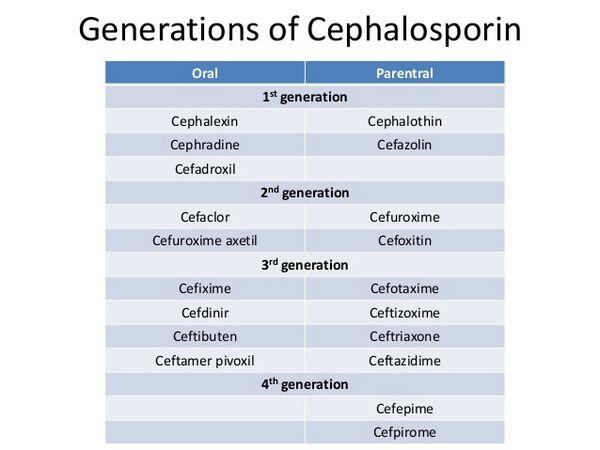
Cephalosporins contain a basic β-lactam structure fused to a six-membered ring. Drugs in this class vary widely in their spectrum of activity, susceptibility to bacterial β-lactamases, and serum half-life. Cephalosporins are categorised into four generations, with each newer generation representing broader bacterial coverage. This generational classification helps clinicians match the drug to the likely causative organism and site of infection.

First-generation agents have the narrowest spectrum of activity among the cephalosporins. They are most active against staphylococci and streptococci. Most first-generation cephalosporins are available as oral formulations. Second-generation agents have increased activity against gram-negative bacilli but are usually less active than first-generation drugs against gram-positive bacteria. Second-generation oral cephalosporins are occasionally used to treat mild episodes of acute exacerbations of chronic bronchitis. Their more targeted spectrum can still be appropriate when the likely bacteria have been identified and are known to be susceptible.
Third-generation cephalosporins are active against gram-negative organisms; however, their activity against gram-positive organisms is inferior to that of earlier generations. These agents are commonly recommended in clinical guidelines as first-line treatment for patients hospitalised with acute exacerbations of chronic bronchitis. Compared with second-generation cephalosporins, third-generation agents have greater stability against β-lactamases and longer serum half-lives. As a result, they have more convenient dosing regimens. Third-generation agents may also be used in combination with macrolides, extended-spectrum penicillins, or aminoglycosides to treat severe acute exacerbations of chronic bronchitis. Fourth-generation agents have enhanced stability against β-lactamases and provide good coverage of both gram-positive and gram-negative bacteria (particularly P. aeruginosa). However, they are generally reserved for severe, life-threatening infections such as sepsis. Selection of a specific agent and regimen should be guided by local resistance patterns and current clinical practice guidelines.
| Generation | Main spectrum focus | Selected clinical notes |
|---|---|---|
| First | Primarily gram-positive cocci | Narrowest spectrum among cephalosporins; many agents available as oral formulations |
| Second | Expanded gram-negative coverage with reduced gram-positive activity | Occasionally used for mild acute exacerbations of chronic bronchitis |
| Third | Enhanced gram-negative activity | Commonly used in hospitalised patients with acute exacerbations of chronic bronchitis; longer half-lives and greater β-lactamase stability than second-generation agents |
| Fourth | Broad gram-positive and gram-negative coverage | Retains activity against many β-lactamase-producing organisms, including P. aeruginosa; generally reserved for severe infections such as sepsis |
As a class, cephalosporins are generally well tolerated. Common adverse effects are usually minor; gastrointestinal (GI) disturbances and thrombophlebitis are most prominent with oral and intravenous (IV) agents, respectively. GI disturbances are reported less often with cephalosporins than with penicillins. Because of their relative safety and broad spectrum of activity, cephalosporins are commonly used to treat suspected as well as confirmed bacterial infections. Patients should discuss any troublesome adverse effects or concerns with a healthcare provider.
As with other β-lactam antibiotics, resistance to cephalosporins results from pathogen changes in outer-membrane permeability, stability against β-lactamases, and modification of penicillin binding proteins. While β-lactamase production by H. influenzae or M. catarrhalis limits the use of certain penicillins such as amoxicillin, many cephalosporins are effective in treating infections caused by these β-lactamase-producing bacteria. Resistance to third-generation cephalosporins in gram-negative pathogens is a major problem in hospital settings and is associated with adverse clinical outcomes and increased hospital costs. Judicious use of cephalosporins and participation in antimicrobial stewardship efforts are important to help slow the spread of resistance.
| Aspect | Summary | Practical point |
|---|---|---|
| Overall tolerability | Generally well tolerated as a class | Useful when a broad-spectrum agent with a favourable safety profile is needed |
| Gastrointestinal effects | GI disturbances occur but are reported less often than with penicillins | Patients should report persistent or severe symptoms to a healthcare provider |
| Injection site reactions | Thrombophlebitis may occur with IV formulations | Careful monitoring of IV sites can help detect and manage local reactions |
| β-lactamase-producing organisms | Many agents remain effective against β-lactamase-producing H. influenzae and M. catarrhalis | Provides options when penicillins such as amoxicillin are limited by resistance |
| Hospital resistance patterns | Resistance to third-generation agents among gram-negative pathogens is a major concern | Local susceptibility data and antimicrobial stewardship guidance should help direct selection |
Mechanism of Action
As with penicillins, the β-lactam ring of cephalosporins binds to penicillin binding proteins in bacteria and prevents bacterial cell-wall formation. By interrupting cell-wall formation, cephalosporins induce cell lysis and death. This bactericidal effect supports the host immune response in clearing susceptible bacterial infections.