



Cysticercosis (Cysticercus cellulosae infection)

Essentials of Diagnosis
- Surgical excision of affected tissue, with microscopic identification of the parasite.
- Frequently calcified cysts seen on X-ray or computed tomography (CT) scans.
- Positive serology indicating previous exposure to T solium.
- Fine-needle aspiration of cysts (characteristic cytomorphology).
General Considerations
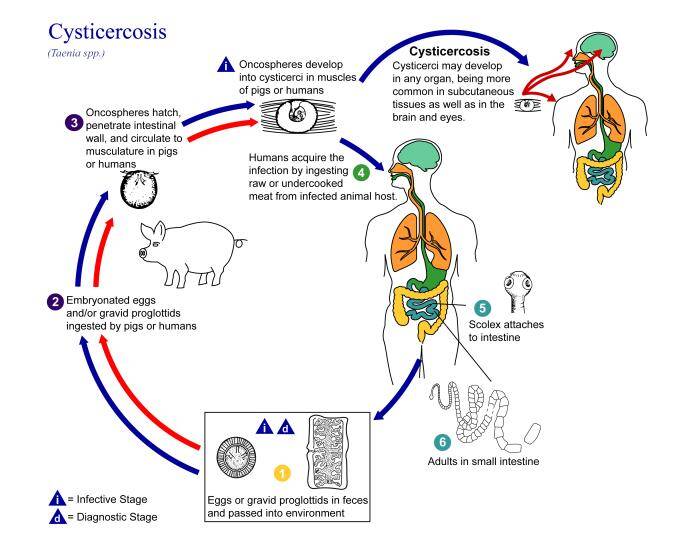
Cysticercosis is caused by invasion of tissue by the larval forms of T solium. These larval forms have been referred to as Cysticercus cellulosea; however, this name is not taxonomically correct and can cause confusion. In a host infected with adult T solium, eggs or proglottids are passed in the stool. When eggs or proglottids are ingested by pigs (intermediate hosts) or humans (definitive and intermediate hosts), the eggs hatch in gastric juice. This process allows the cysticercus to migrate from the intestine to disseminated sites via efferent mesenteric venules. Autoinfection can also occur in humans, where eggs produced by the adult intestinal worm hatch and invade the intestinal epithelium.
Clinical Findings
Signs and Symptoms
Symptoms associated with cysticercosis depend on the organ invaded by cysticerci and the inflammatory reaction to the larva. In the brain, cysticercosis may cause arachnoiditis or chronic meningitis, with associated headache, vertigo, vomiting, and cranial neuropathies. Other presentations include obstructive hydrocephalus with ataxia and dementia, intracranial vasculitis with focal neurologic signs and neuropsychiatric changes, or mass effect with seizures, headache, or focal neurologic deficits. In addition, spinal cord compression with lower limb weakness and loss of bowel and bladder continence may occur. Cysts outside the central nervous system tend to occur in muscle, are most often asymptomatic, and eventually die, calcify, and may be detected incidentally on radiographs. Occasionally, muscle cysts cause pseudohypertrophy, which may be associated with myositis, high fever, and eosinophilia. Cysts may also occur in critical organs (most commonly the heart and liver), where they present as mass lesions with pain or obstructive symptoms.
Clinical appearance therefore ranges from incidentally noted calcifications to severe neurologic compromise. The same patient may have both asymptomatic and symptomatic lesions in different organs.
| Site | Typical manifestations | Examples from text |
|---|---|---|
| Brain and meninges | Inflammation, mass effect, CSF flow obstruction | Arachnoiditis, chronic meningitis, obstructive hydrocephalus, seizures, focal neurologic deficits, dementia |
| Spinal cord | Compression and neurologic deficits | Cord compression with lower limb weakness and loss of bowel and bladder continence |
| Skeletal muscle | Often asymptomatic; occasionally inflammatory | Incidental calcified cysts, pseudohypertrophy, myositis, high fever, eosinophilia |
| Viscera (heart, liver, other organs) | Mass lesions and obstruction | Pain or obstructive symptoms, such as biliary obstruction in hepatic cysticercosis |
Laboratory Findings
Patients with cysticercosis may have a mild elevation in the leukocyte count, possibly with eosinophilia. In patients with meningitis associated with neurocysticercosis, cerebrospinal fluid examination may show either lymphocytic or eosinophilic pleocytosis, hypoglycorrhachia, and elevated protein. A serologic test for T solium has recently been developed, but its performance characteristics remain to be validated. False-positive results have been associated with infections caused by other cestodes. A negative serologic test does not exclude the diagnosis of cysticercosis.
Imaging
Living cysts associated with cysticercosis are often multiple and have a characteristic appearance on CT scans or magnetic resonance images, as enhancing and nonenhancing unilocular cysts. Patients with extraneurologic cysticercosis may have painless subcutaneous nodules, often on the shins, which are calcified and have a characteristic appearance on plain radiographs.
| Diagnostic method | Role | Selected features |
|---|---|---|
| Surgical excision and histology | Definitive identification | Microscopic identification of larval parasite in excised tissue |
| Fine-needle aspiration | Cytologic confirmation | Characteristic cytomorphology of cysticerci |
| Serologic testing | Evidence of exposure | Positive results suggest prior exposure to T solium; false positives with other cestodes; negative test does not exclude disease |
| CT / MRI of brain and spine | Neurocysticercosis evaluation | Multiple enhancing and nonenhancing unilocular cysts; assessment of hydrocephalus and mass effect |
| Plain radiographs | Detection of calcified cysts | Calcified subcutaneous or intramuscular nodules, often on the shins |
Differential Diagnosis
Patients who seek care for symptoms of infection with T solium most commonly do so because of the neurologic symptoms associated with neurocysticercosis. The most common neurologic symptoms are mass effect and seizures (related to intraparenchymal lesions), hydrocephalus (related to intraventricular cysts), chronic meningitis (related to subarachnoid cysts), and cord compression (owing to spinal cord cysts). The differential diagnosis of each of these symptom patterns is beyond the scope of this discussion; however, malignancy can present in identical ways and must be excluded.
Complications
Visceral cysticercosis is also commonly asymptomatic, but it may obstruct local structures (eg, biliary obstruction in hepatic cysticercosis). Neurocysticercosis may lead to permanent neurologic impairment, coma, or death.
Treatment
Treatment of cysticercosis includes surgery when feasible and necessary, in combination with praziquantel or albendazole. Treatment commonly increases local inflammation, which can transiently cause a paradoxical worsening of the patient's symptoms. Whether corticosteroids should be used as adjunctive therapy for patients treated for neurocysticercosis remains debated.
Decisions about the timing of surgery, the choice of antiparasitic drug, and the use of anti-inflammatory therapy are typically individualised based on cyst location, burden, and the severity of neurologic involvement.
Prognosis
The mortality rate for untreated neurocysticercosis approaches 50%, but treatment decreases this rate to 5-15%.
Prevention & Control
Guidelines for prevention of cysticercosis are the same as those for prevention of T solium infection. These measures include proper cooking of pork, careful hand hygiene, and adequate sanitation to prevent faecal contamination of food and water.