



Fluoroquinolones: levofloxacin, moxifloxacin, gatifloxacin

Fluoroquinolones are broad-spectrum antibacterials that have seen a marked increase in use in recent years.
Because of their broad-spectrum activity, high efficacy, favourable dosing, and availability in oral and IV forms, these agents are indicated for a range of bacterial infections, including respiratory, gastrointestinal, and urinary tract infections.
Earlier generations of fluoroquinolones (e.g., ofloxacin) had limited activity against some respiratory pathogens, such as S. pneumoniae. However, more recent fluoroquinolone agents (so-called third-generation agents, or the "respiratory fluoroquinolones") are active against a broad spectrum of gram-positive and gram-negative bacteria, including atypical organisms.
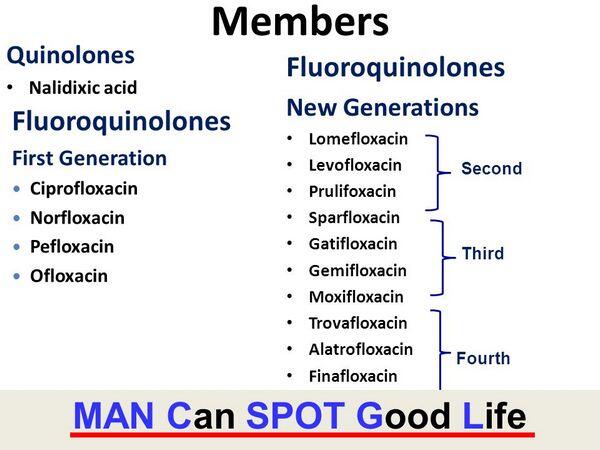
Therefore, they are highly effective in respiratory tract infections (RTIs). An important factor influencing the use of recently launched fluoroquinolones is the withdrawal from the market of several agents in this class due to toxicity-for example, trovafloxacin (Pfizer's Trovan) and grepafloxacin (GSK's Raxar).
In addition, fluoroquinolones as a class are associated with alterations in normal cardiac conduction (i.e., prolongation of the QT interval) that can cause cardiac arrhythmias in vulnerable patients. The degree of QT prolongation varies between agents; sparfloxacin (Mylan's Zagam) and grepafloxacin have been associated with the greatest QTc prolongation, and both agents have been removed from the US market. Another important limitation of fluoroquinolones is that they are generally contraindicated in children and pregnant women because animal studies have shown toxicity to growing cartilage. They are used in some severe paediatric infections-for example, in patients with cystic fibrosis-but this is generally the exception.
Research in this area is ongoing. Until recently, fluoroquinolone resistance among respiratory pathogens has been extremely rare. However, increasing fluoroquinolone resistance in S. pneumoniae isolates has been reported, and clinical failures with levofloxacin have been noted in Canada.
Fluoroquinolone-resistant isolates are more common in people older than 65 years, who have the highest level of fluoroquinolone use.
Prior exposure to fluoroquinolones is one of the major risk factors for acquisition of levofloxacin-resistant S. pneumoniae. Emerging resistance to older fluoroquinolones, such as ciprofloxacin, has been demonstrated worldwide, ranging from 3% to 12%. In comparison, penicillin-resistant strains are more common in isolates from young children, who have the highest rate of β-lactam use. Fluoroquinolone resistance often involves alteration of their targets, the topoisomerases.
| Aspect | Key points | Notes from text |
|---|---|---|
| Spectrum and indications | Broad-spectrum activity with oral and IV options | Used for respiratory, gastrointestinal, and urinary tract infections |
| Respiratory activity | Improved coverage with newer "respiratory fluoroquinolones" | Active against S. pneumoniae, gram-positive and gram-negative bacteria, and atypical organisms |
| Cardiac safety | Risk of QT interval prolongation and arrhythmias | Greatest QTc prolongation noted with sparfloxacin and grepafloxacin; both removed from the US market |
| Use in children and pregnancy | Generally contraindicated | Cartilage toxicity in animal studies; limited use in severe paediatric infections such as cystic fibrosis |
| Resistance patterns | Traditionally rare, now increasing | Rising resistance in S. pneumoniae; prior fluoroquinolone exposure and older age are important risk factors |
Mechanism of Action
Fluoroquinolones interact with two related yet distinct targets within the bacterial cell: DNA gyrase and topoisomerase IV. These enzymes are essential for bacterial DNA replication. Fluoroquinolones are potent inhibitors of nucleic acid synthesis.

The exact nature of the interaction between quinolones and their target enzymes is not completely understood; however, this interaction blocks the progression of DNA replication, leading to strand breaks and rapid cell death. Inhibition of DNA gyrase is bactericidal, whereas inhibition of topoisomerase IV is primarily bacteriostatic.
| Target enzyme | Main role in bacteria | Effect of fluoroquinolone inhibition |
|---|---|---|
| DNA gyrase | Controls DNA replication and supercoiling | Blocks progression of DNA replication, causes strand breaks, and leads to rapid bactericidal activity |
| Topoisomerase IV | Helps separate replicated DNA strands | Interferes with DNA replication and cell division, producing primarily bacteriostatic effects |