



Taenia solium infection

Essentials of Diagnosis
- Spheroidal yellow-brown eggs (31-43 µm).
- Scolex has hooklets and four suckers.
- Proglottids usually appear as short chains.
- Mature proglottids are square and non-motile.
- Gravid proglottid has 7-13 lateral branches on each side of the uterus.
General Considerations
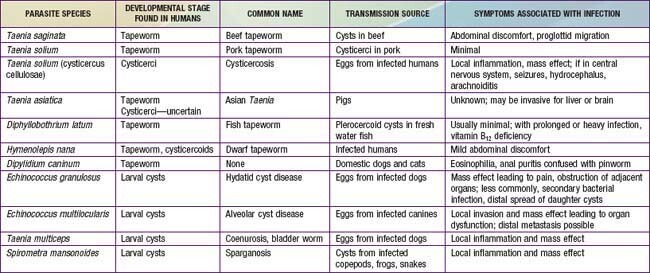
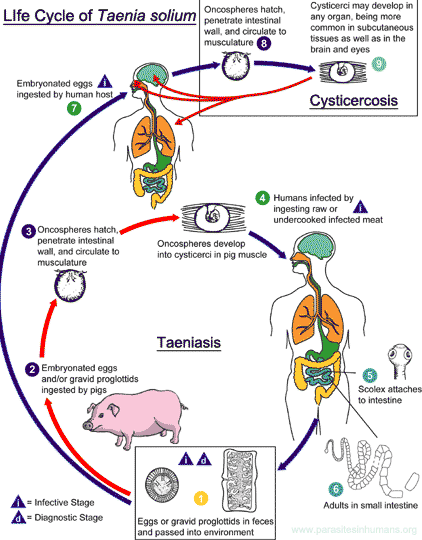
T solium infection occurs worldwide; endemic areas include Mexico, South and Central America, Africa, South-East Asia, India, and the Philippines. T solium infection is commonly linked to ingestion of undercooked pork, although other animals may harbour the larval form of the parasite. Infection may be intestinal, which is typically asymptomatic, or extraintestinal (called cysticercosis), which is caused by larval forms of T solium within the tissues of the human host. Ingestion of encysted T solium larvae is followed by attachment of the parasite scolex to the intestinal mucosa, which allows the worm to grow into an adult within 12 weeks. One or more adult worms may be present for up to 25 years, and they may reach lengths of 2 to 7 m. Each worm contains fewer than 1000 proglottids. Species identification is based on the number of lateral branches on the side of the uterus within a gravid proglottid.
| Feature | Finding in T solium | Comment |
|---|---|---|
| Eggs | Spheroidal, yellow-brown, 31-43 µm | Seen on stool examination in intestinal infection. |
| Scolex | Hooklets present with four suckers | Helps distinguish T solium from T saginata when the scolex is recovered. |
| Proglottids in stool | Usually appear as short chains | Patients may notice segments in stool or on clothing. |
| Mature proglottids | Square and non-motile | Motility differences are useful when comparing Taenia species. |
| Gravid proglottids | 7-13 lateral branches on each side of the uterus | Branch counts are a major criterion for species identification. |
| Larval disease | Extraintestinal cysticercosis may occur | Raises concern for central nervous system and other tissue involvement. |
Clinical Findings
Signs and Symptoms
Infection with the adult worm of T solium is usually asymptomatic, but non-specific abdominal symptoms, including indigestion and nausea, may be present.
Because symptoms are often mild, recognition frequently depends on detection of eggs or segments on routine stool examination, or in samples submitted after patients notice material in stool.
Laboratory Findings
Patients with intestinal T solium infection will frequently have abnormal results on stool examinations for ova and parasites and, occasionally, will have a mild leukocytosis with eosinophilia.
Differential Diagnosis
Because infection with the adult worm of T solium is usually asymptomatic, the main diagnostic concern in a patient with intestinal T solium infection is whether the patient has cysticercosis. If the results of evaluation suggest extraintestinal infection, then specific therapy for cysticercosis is required.
Complications
T solium infection of the intestine is not commonly associated with symptoms; however, in patients with high parasite loads, obstruction may occur.
Treatment
Treatment for intestinal T solium infection consists of either praziquantel or niclosamide. Follow-up stool examinations should be performed 1 month after treatment.
Repeat stool testing helps confirm clearance of the tapeworm and is particularly important when there is concern about ongoing exposure or incomplete adherence to treatment.
Prognosis
The prognosis for patients with intestinal T solium infection is excellent.
Prevention & Control
Prevention of T solium infection involves thoroughly cooking pork and pork products to a core temperature of at least 149 °F (65 °C). Freezing, pickling, and salting do not prevent infection. Immunisation of swine and provision of animal feed that is free of eggs and proglottids are other preventive measures that have been reported to be effective in controlling infection. Since infected humans can transmit cysticercus to others, enteric precautions should be used, and stool specimens should be handled with attention to decontamination. In addition, adequate facilities for disposal of human sewage should be available.
| Target | Strategy | Examples |
|---|---|---|
| Foodborne transmission | Safe cooking of pork | Cook pork and pork products until the internal temperature reaches at least 149 °F (65 °C) before serving. |
| Animal reservoir | Control in swine | Immunisation of pigs where available, and provision of feed that is free of human faecal contamination, eggs, and proglottids. |
| Human source of infection | Enteric precautions and sanitation | Careful hand hygiene, safe handling of stool specimens, and adequate sewage disposal to limit spread of eggs from infected individuals. |