I'm in Cairns. Can I enter my postcode before paying to see whether these tablets can be delivered to me?
Yes. Enter your Cairns postcode at checkout to check whether delivery is available for your address before you complete the order.


 AntiInfectiveMeds
Since 2010
AntiInfectiveMeds
Since 2010

| Quantity | Price per tablet | You save | Total price | |
|---|---|---|---|---|
| 30 | A$2.61 | - | A$78.24 | |
| 60 | A$2.23 | A$22.90 | A$133.57 | |
| 90 | A$2.02 | A$53.34 | A$181.37 | |
| 120 | A$1.75 | A$103.27 | A$209.67 | |
| 180 | A$1.58 | A$184.35 | A$285.06 | |
| 270 | A$1.45 | A$313.94 | A$390.18 | |
| 360 | A$1.31 | A$465.43 | A$473.40 |
Your order is carefully packed and ships within 24 hours. Here is what a typical package looks like.
Sized like a regular personal letter (approximately 24x11x0.7 cm), with no indication of what is inside.



| Delivery Method | Estimated delivery |
|---|---|
| Express Free for orders over A$426.74 | Estimated delivery to Australia: 4-7 days |
| Standard Free for orders over A$284.50 | Estimated delivery to Australia: 14-21 days |












Combivir is used to treat HIV (human immunodeficiency virus) infection in adults and children.
Combivir contains two active ingredients used to treat HIV infection: lamivudine and zidovudine. Both belong to a group of antiretroviral medicines called nucleoside analogue reverse transcriptase inhibitors (NRTIs).
Combivir does not completely cure HIV infection. It reduces the amount of virus in your body and helps keep it at a low level. It also increases the CD4 cell count in your blood. CD4 cells are a type of white blood cell that help your body fight infection.
Not everyone responds to treatment with Combivir in the same way. Your doctor will monitor how well your treatment is working.
Check with your doctor if you think any of these apply to you.
Some people taking Combivir or other combination treatments for HIV have a higher risk of serious side effects. You need to be aware of these extra risks:
Talk to your doctor if any of these apply to you. Your doctor will decide whether the active ingredients are suitable for you. You may need extra check-ups, including blood tests, while you're taking this medicine. See Section 4 for more information.
Some people taking medicines for HIV infection develop other conditions, which can be serious. You need to know which important signs and symptoms to watch for while you're taking Combivir.
HIV infection is spread through sexual contact with someone who has the infection, or through transfer of infected blood (for example, by sharing needles). Combivir will not stop you passing HIV infection on to other people. To help protect other people from becoming infected with HIV:
Use a condom when you have oral or penetrative sex.
Don't risk blood transfer - for example, don't share needles.
Tell your doctor or pharmacist if you're taking any other medicines, or if you've taken any recently, including herbal medicines or medicines you bought without a prescription.
Remember to tell your doctor or pharmacist if you start taking a new medicine while you're taking Combivir.
Tell your doctor if you're being treated with any of these.
Some medicines can make side effects more likely, or make them worse.
These include:
Tell your doctor if you're taking any of these.
These include:
Tell your doctor if you're taking phenytoin. Your doctor may need to monitor you while you're taking Combivir.
If you are pregnant, if you become pregnant, or if you are planning to become pregnant, talk to your doctor about the risks and benefits to you and your baby of taking Combivir.
Combivir and similar medicines may cause side effects in unborn babies. If you become pregnant while you're taking Combivir, your baby may need extra check-ups, including blood tests, to make sure they are developing normally.
Children whose mothers took NRTIs (medicines like Combivir) during pregnancy had a reduced risk of being infected with HIV. This benefit is greater than the risk of side effects.
Women who are HIV-positive must not breastfeed, because HIV infection can be passed on to the baby in breast milk.
If you're breastfeeding or thinking about breastfeeding:
Talk to your doctor straight away.
Combivir can make you dizzy and may cause other side effects that make you less alert. Don't drive or use machines unless you're feeling well.
Always take Combivir exactly as your doctor has told you to. Check with your doctor or pharmacist if you're not sure.
Swallow Combivir tablets with some water. Combivir can be taken with or without food.
If you cannot swallow the tablets whole, you may crush them and mix them with a small amount of food or drink, then take the full dose straight away.
Stay in regular contact with your doctor.
Combivir helps to control your condition. You need to keep taking it every day to stop your illness getting worse. You may still develop other infections and illnesses linked to HIV infection.
Keep in touch with your doctor, and don't stop taking Combivir without your doctor's advice.
The usual dose of Combivir is one tablet twice a day.
Take the tablets at regular times, leaving about 12 hours between each tablet.
The usual starting dose of Combivir is half a tablet in the morning and one whole tablet in the evening.
The usual starting dose of Combivir is half a tablet in the morning and half a tablet in the evening.
For children who weigh less than 14 kg, lamivudine and zidovudine (the ingredients of Combivir) should be taken separately.
If you accidentally take too much Combivir, tell your doctor or pharmacist, or contact your nearest hospital emergency department for further advice.
If you forget to take a dose, take it as soon as you remember. Then continue your treatment as before. Don't take a double dose to make up for a missed dose.
Like all medicines, Combivir can cause side effects, although not everyone gets them.
When you're being treated for HIV, it can be hard to tell whether a symptom is a side effect of Combivir or other medicines you're taking, or an effect of HIV itself. That's why it's very important to talk to your doctor about any changes in your health.
As well as the side effects listed below for Combivir, other conditions can develop during combination therapy for HIV. It is important to read the information later in this section under 'Other possible side effects of combination therapy for HIV.'
These may affect more than 1 in 10 people:
These may affect up to 1 in 10 people:
These may affect up to 1 in 100 people:
An uncommon side effect that may show up in a blood test is:
These may affect up to 1 in 1000 people:
These may affect up to 1 in 10,000 people:
Tell your doctor or pharmacist if any side effects become severe or troublesome, or if you notice any side effects not listed in this leaflet.
Combination therapy such as Combivir may cause other conditions to develop during HIV treatment.
People with advanced HIV infection (AIDS) have weak immune systems and are more likely to develop serious infections (opportunistic infections). When these people start treatment, they may find that old, hidden infections flare up, causing signs and symptoms of inflammation. These symptoms are probably caused by the body's immune system becoming stronger, so the body starts to fight these infections. If you get any symptoms of infection while you're taking Combivir:
Tell your doctor straight away. Don't take other medicines for the infection without your doctor's advice.
People taking combination therapy for HIV may notice changes in their body shape because of changes in fat distribution:
Fat may be lost from the legs, arms or face.
Extra fat may build up around the tummy (abdomen), or on the breasts or internal organs.
Fatty lumps (sometimes called buffalo hump) may appear on the back of the neck.
It is not yet known what causes these changes, or whether they have any long-term effects on your health. If you notice changes in your body shape, tell your doctor.
Some people taking Combivir, or other medicines like it (NRTIs), develop a condition called lactic acidosis, together with an enlarged liver.
Lactic acidosis is caused by a build-up of lactic acid in the body. It is rare. If it happens, it usually develops after a few months of treatment. It can be life-threatening, causing failure of internal organs. Lactic acidosis is more likely to develop in people who have liver disease, or in obese (very overweight) people, especially women.
Signs of lactic acidosis include:
During your treatment, your doctor will monitor you for signs of lactic acidosis. If you have any of the symptoms listed above, or any other symptoms that worry you:
See your doctor as soon as possible.
Some people taking combination therapy for HIV develop a condition called osteonecrosis. With this condition, parts of the bone tissue die because of reduced blood supply to the bone. People may be more likely to get this condition:
Signs of osteonecrosis include:
If you notice any of these symptoms, tell your doctor.
Combination therapy for HIV can also cause:
Keep Combivir out of the sight and reach of children.
Do not take Combivir after the expiry date shown on the carton.
Do not store above 30°C.
If you have any unwanted Combivir tablets, don't dispose of them in wastewater or household rubbish. Ask your pharmacist how to dispose of medicines you no longer need. These measures will help protect the environment.
The active substances are lamivudine and zidovudine. The other ingredients are:
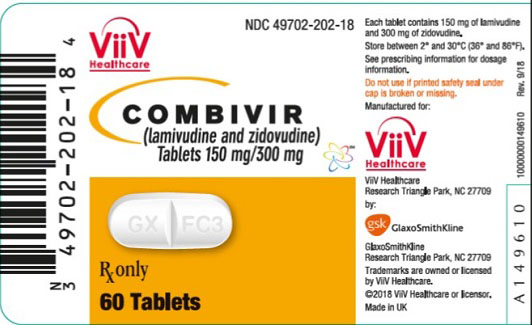
Combivir film-coated tablets are supplied in tamper-evident blister packs containing 60 tablets. They are white to off-white, capsule-shaped scored tablets marked with the code GXFC3 on both sides.

I'm in Cairns. Can I enter my postcode before paying to see whether these tablets can be delivered to me?
Yes. Enter your Cairns postcode at checkout to check whether delivery is available for your address before you complete the order.
My parcel arrived in Canberra after a very hot day. What should I check before I take the tablets?
Check that the package is intact and dry and that the tablets are not discoloured, crumbled or otherwise damaged. They should be stored between 2°C and 30°C.
I live in Broome, outside a major city. How can I find out whether you can deliver this medicine to my area?
Enter your Broome address and postcode at checkout. The checkout process will show whether delivery to your location is available before payment.
I need to drive for work after starting lamivudine and zidovudine. Is it safe to drive after my first dose?
Some people develop dizziness, headache or fatigue. Avoid driving or using machinery until you know how the tablets affect you; if these effects occur, do not drive.
| Active ingredient | Lamivudine and zidovudine |
|---|---|
| Drug class | Antiretroviral combination of nucleoside reverse transcriptase inhibitors (NRTIs) |
| Dosage form | Tablet |
| Available strengths | 150 mg/300 mg |
| Route | Oral |
| Storage | Store between 2°C and 30°C in a tightly closed container, away from excess moisture. |
| ATC code | J05AR01 |
This product has 6 ratings, but only 5 written reviews so far. Share your experience and help other customers.
Packaging was neat and secure.
Order arrived as expected.
I asked about delivery before ordering, and support answered clearly.
An incorrect street number was corrected by support before dispatch.
The parcel's plain exterior gave nothing away about the contents.


