I live in Bendigo. Can I enter my postcode before paying to check whether Ciprodex can be delivered to my address?
Yes. Enter your Bendigo postcode at checkout to check whether delivery is available for your address before completing the order.


 AntiInfectiveMeds
Since 2010
AntiInfectiveMeds
Since 2010

| Quantity | Price per bottle | You save | Total price | |
|---|---|---|---|---|
| 2 | A$23.19 | - | A$46.37 | |
| 3 | A$20.15 | A$9.10 | A$60.46 | |
| 4 | A$15.75 | A$29.73 | A$63.02 | |
| 5 | A$13.57 | A$48.08 | A$67.85 |
Your order is carefully packed and ships within 24 hours. Here is what a typical package looks like.
Sized like a regular personal letter (approximately 24x11x0.7 cm), with no indication of what is inside.



| Delivery Method | Estimated delivery |
|---|---|
| Express Free for orders over A$426.74 | Estimated delivery to Australia: 4-7 days |
| Standard Free for orders over A$284.50 | Estimated delivery to Australia: 14-21 days |












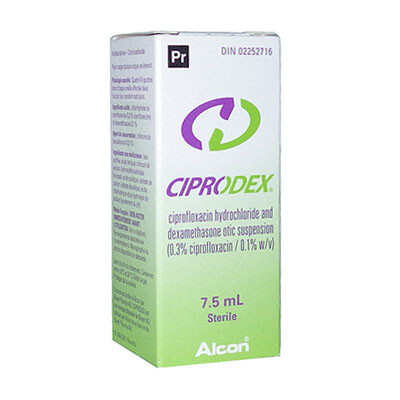
Ciprodex is a combined liquid medicine (2 active ingredients) used only to treat ear infections caused by bacteria. This medicine (sterile solution, 7.5 mL) is placed into the ears. It must not be swallowed, injected or used in any other way.
The aims of treatment are to clear the infection, ease pain or swelling, and help prevent complications. In Australia, treatment choices are usually guided by a doctor based on the type and severity of the infection.
Unless your doctor tells you otherwise, this medicine may be suitable for:
This solution is not intended for children under 6 months of age.
Ciprodex is a combined anti-infective medicine. It contains two active ingredients that work together at the site of infection.
The active ingredients in Ciprodex are:
The standard dose of 4 drops corresponds to 0.42/0.14 mg of ciprofloxacin/dexamethasone.
The solution also contains inactive ingredients that help form the product in this dosage form.
Ciprofloxacin HCl is an antimicrobial medicine (a second-generation fluoroquinolone antibiotic). It has been used since the mid-1980s to treat a wide range of infections affecting different parts of the body and caused by different pathogens.
 This ingredient has strong bactericidal activity against most susceptible bacteria. Because of these properties, it can be used to treat infections of different severity, including severe infections.
When Ciprodex ear drops and their active ingredient ciprofloxacin HCl enter a bacterial cell through the outer membrane, the following happens:
The pathogens are destroyed with minimal release of bacterial structural components (endotoxins), which helps reduce the risk of complications.
Dexamethasone is a synthetic corticosteroid with anti-inflammatory activity, similar to a naturally occurring hormone produced by the adrenal glands. It was synthesised in the 1960s and is used to treat a range of conditions, including skin, eye and ear conditions.
Bacterial infections are often linked with inflammation, especially in children. Dexamethasone has been added to the formulation to help reduce this inflammatory response.
This medicine comes in plastic bottles (DROP-TAINER) designed to make it easier to use liquid medicine. These dropper bottles help deliver drops of the same size.
In most cases, Ciprodex dosing is the same for all patients. It does not depend on age, the type of condition, the severity of the infection, or the type of microorganism causing it.
Important: read the instructions for putting in the drops and using the DROP-TAINER bottle correctly. After putting in the drops, patients with AOE should apply light pressure to the tragus (the small cartilaginous prominence on the outer ear). This helps the medicine enter the middle ear.
Treatment works best when the drops are used at the same times each day. It helps to plan a dosing schedule in advance and stick to it for the whole course.
The effectiveness and safety of Ciprodex have been studied in clinical trials. Results showed that the medicine provides the expected effect regardless of the severity of the patient's condition, age and other factors.
Usually, the benefits of Ciprodex outweigh the potential risks. As with any treatment for infectious diseases, Ciprodex ear drops can cause side effects and are not suitable for every patient.
The drops mainly act on the surface of the ear and only very small amounts are absorbed into the bloodstream. Systemic exposure is negligible, so most side effects are local.
Side effects reported with Ciprodex include:
If your body tolerates Ciprodex well, the risk of these reactions is low. Even if they do occur, they are generally not hazardous, are usually well tolerated, and pass quickly. Side effects are not usually a reason to stop treatment on your own.
Allergic reactions may occur if Ciprodex comes into contact with the skin or if ingredients are absorbed into the body. Signs of hypersensitivity, such as shortness of breath or a rash, should not be ignored. These reactions can be severe and need immediate medical attention.
The dosage of Ciprodex for children is the same as for adults. In young children, the ear canals are narrower than in adults, which can make administration harder. Children are also often nervous about unfamiliar procedures and may resist.
Read the Ciprodex ear drops instructions before giving this medicine to a child or adult.
The effectiveness and safety of antibacterial treatment depend greatly on following these recommendations:
Special studies on the effects of Ciprodex in pregnant women have not been carried out. It is not known whether this medicine may harm the fetus.
It is also not known whether the active ingredients can be absorbed in amounts large enough to be detected in breast milk and passed to a breastfed infant.
Ciprodex is used topically, but no medicine is completely risk-free. Discuss this with your doctor. The benefits for the mother must outweigh any potential risks to the fetus or baby.
Ciprodex should only be used when needed. Always complete the full course of treatment.
Long-term antibiotic use increases the risk of fungal infections. Do not use broad-spectrum antibiotics for longer than prescribed.
Ciprodex is contraindicated or should be delayed in the following cases:
Based on clinical trials and post-marketing reports, Ciprodex has not been shown to impair the ability to:
Do not store this medicine in a damaged bottle.
Do not store this medicine without the screw cap. This can change the properties of the solution or lead to contamination. The dropper tip must remain sterile. Keep the bottle tightly closed when you are not using the ear drops.
Do not use Ciprodex after the expiry date.
Store Ciprodex ear suspension (7.5 mL) in a dark place to protect it from daylight and UV rays. Exposure can degrade the active ingredients.
The optimal storage temperature is between 15°C (59°F) and 30°C (86°F). Avoid freezing.
Store this medicine out of reach of children and pets.

I live in Bendigo. Can I enter my postcode before paying to check whether Ciprodex can be delivered to my address?
Yes. Enter your Bendigo postcode at checkout to check whether delivery is available for your address before completing the order.
My parcel arrived in Bunbury after a very hot day. What should I check before I use the ear drops?
Check that the bottle and package are intact, with no leaks or visible change in the suspension, and review the label storage directions: 20°C to 25°C, protected from light and not frozen.
I take warfarin every day for a previous clot. Are these ear drops likely to interfere with it?
Clinically significant interactions with warfarin are not expected from ciprofloxacin and dexamethasone ear suspension because absorption after ear use is minimal. Let the prescriber or pharmacist know about warfarin and any other medicines, particularly if you have unusual bleeding or your anticoagulation treatment is being adjusted.
| Active ingredient | Ciprofloxacin and dexamethasone |
|---|---|
| Drug class | Fluoroquinolone antibiotic and corticosteroid combination |
| Dosage form | Ear suspension |
| Available strengths | Ciprofloxacin 0.3% and dexamethasone 0.1% |
| Route | Ear |
| Storage | Store at 20°C to 25°C. Avoid freezing. Protect from light. |
| ATC code | S02CA06 |
This product has 6 ratings, but only 5 written reviews so far. Share your experience and help other customers.
Excellent quality overall.
I'd order from here again.
They sent it out quickly.
The secure inner packaging kept the medicine from moving about, and it arrived undamaged.
The discreet outer packaging kept the contents from being obvious around others - pretty handy.


