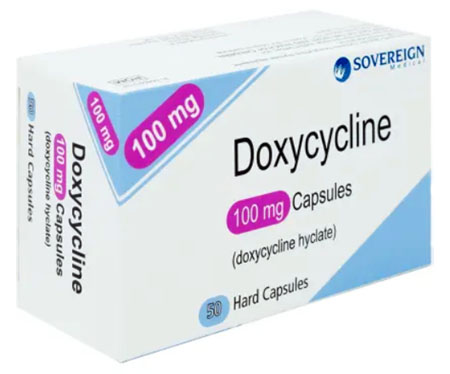
Doxycycline is a tetracycline antibiotic used to treat a wide range of susceptible bacterial infections. In Australia, it is also used for selected preventive regimens, such as in travel medicine, and for other specialist-guided indications.
Other doxycycline options: Doxycycline comes in several dosage forms (availability varies by market), including oral suspension (liquid), delayed-release formulations, and an intravenous (IV) form used in hospital settings.
Also available: Vibramycin-D (dispersible tablets) is another doxycycline option. These tablets are designed to be dissolved in water before taking, which may help if you have trouble swallowing tablets. Availability may vary.
| Dosage form |
Typical use |
Key practical notes |
Where you usually see it |
| Tablets / capsules |
Most outpatient treatment courses |
Take with a full glass of water; don't lie down straight after |
Home / pharmacy |
| Oral suspension (liquid) |
People who have trouble swallowing tablets or capsules |
Shake well; measure doses accurately; follow the storage directions on the label |
Home / pharmacy |
| Delayed-release formulations |
Selected indications/products; may improve GI tolerability for some patients |
Follow the product-specific instructions (don't assume it's the same as immediate-release) |
Home / pharmacy |
| IV (intravenous) |
When oral treatment isn't practical or in specialist settings |
Given by healthcare professionals |
Hospital / clinic |
How to take
- Take each dose with a full glass of water (about 8 oz / 240 mL).
- Swallow it while sitting or standing; do not take it right before lying down. This helps reduce the risk of oesophageal irritation or ulceration.
- If it upsets your stomach, doxycycline can be taken with food.
- Complete the course exactly as prescribed (do not stop early unless your prescriber tells you to).
Timing guide: food, minerals, and common add-ons
| What you take |
Why it matters |
Practical timing |
Notes |
| Milk/dairy |
May affect absorption for some products or patients |
If possible, avoid taking it at the same time |
If nausea occurs, taking doxycycline with a light meal may help |
| Antacids (Ca/Mg/Al), bismuth |
Can bind doxycycline and reduce absorption |
Separate by a few hours (follow your pharmacist's advice or the label directions) |
Common examples: heartburn medicines |
| Iron, zinc, magnesium, calcium supplements |
Can bind doxycycline and reduce absorption |
Separate by a few hours (follow your pharmacist's advice or the label directions) |
Includes many multivitamins |
| Food (general) |
May improve stomach tolerability |
OK with food if needed |
Avoid lying down after taking your dose |
If you miss a dose
| Situation |
What to do |
What to avoid |
When to get advice |
| You remember soon after the scheduled time |
Take the missed dose as soon as you remember |
Don't take it without water or right before lying down |
If you're unsure about spacing with minerals or antacids, ask a pharmacist |
| It's almost time for your next dose |
Skip the missed dose and take the next dose at the usual time |
Do not double the next dose |
If you miss more than one dose, ask your prescriber what to do |
| You vomit soon after a dose |
Ask a pharmacist or clinician whether you should repeat the dose |
Don't automatically take another dose without advice |
Get advice if vomiting is persistent or severe |
Uses and Administration
Doxycycline is a tetracycline derivative with uses similar to tetracycline. It may sometimes be preferred to other tetracyclines for susceptible infections because its absorption is fairly reliable and its long half-life allows less frequent dosing, often once daily. It also has the advantage that it can be used, with care, in patients with renal impairment. However, relatively high doses may be needed for urinary tract infections because of its low renal excretion.
Tooth infection (dental infection): Antibiotics are not a substitute for dental procedures (for example, drainage or definitive dental treatment). In many cases, urgent dental treatment is prioritised and antibiotics are reserved for cases with systemic involvement or a higher risk of spread. An Australian clinician or dentist may prescribe an antibiotic based on the suspected organisms and your allergy history.
What doxycycline is not for (common misconceptions)
| Common request |
Reality |
What to do instead |
| 'Antibiotics for a toothache' |
Dental pain often needs dental treatment (for example, drainage or a procedure), not just antibiotics |
See a dentist urgently, especially if you have swelling or fever |
| 'It will treat any STI' |
Doxycycline is not first-line for gonorrhoea under current Australian guidance |
Get tested and follow guideline-based treatment |
| "It works for colds/flu" |
Colds and flu are usually viral; antibiotics won't help |
Use supportive care; see a clinician if symptoms are severe or getting worse |
| 'I can use leftovers whenever I feel sick' |
Using the wrong drug, dose, or duration increases the risk of treatment failure and antibiotic resistance |
Only use a prescribed course for your current condition |
Doxycycline is usually given by mouth as the base or one of its various salts, usually the hyclate. Doses are expressed in terms of doxycycline; doxycycline hyclate 115 mg is equivalent to about 100 mg of anhydrous doxycycline.
An Australian researcher who has studied doxycycline is Prof. David M. Whiley, PhD, a professor and molecular microbiologist at The University of Queensland.
Typical adult dosing (examples)
The usual adult dose, either by mouth or intravenously, is 200 mg of doxycycline on the first day (as a single dose or in divided doses), followed by 100 mg daily. In severe infections, the initial dosage may be continued throughout the course of treatment (as prescribed).
Gonorrhoea note (Australia): Doxycycline is not a first-line treatment for gonorrhoea under current Australian guidance. Recommended treatment typically includes ceftriaxone; doxycycline may be used only when a clinician is also treating possible chlamydial infection and when appropriate.
For syphilis in penicillin-allergic patients, doxycycline 100 to 200 mg twice daily is given by mouth for at least 14 days; some authorities suggest giving the same dose for 28 to 30 days in patients with late latent disease (follow specialist guidance).
For malaria prevention, doxycycline chemoprophylaxis should begin 1-2 days before travel to endemic areas, be taken once daily during travel, and continue daily for 4 weeks after leaving the endemic area (follow travel medicine guidance).
Interactions
Minerals and antacids (especially products containing calcium, magnesium, aluminium, iron, zinc, or bismuth) can reduce doxycycline absorption-use the timing guide above. Some medicines that induce liver enzymes (for example, rifampicin and certain antiepileptics) may reduce doxycycline levels, so tell your prescriber about all medicines and supplements you take.
Alcohol
Occasional alcohol use is not known to cause a disulfiram-like reaction with doxycycline. However, chronic heavy alcohol use may reduce doxycycline exposure, which could make it less effective. If you drink heavily or have alcohol use disorder, discuss this with your prescriber.
Adverse Effects and Precautions
Common side effects
- Stomach upset (nausea, vomiting), diarrhoea, loss of appetite
- Throat or oesophageal irritation (especially if taken without enough water or right before lying down)
- Photosensitivity (you may sunburn more easily) - use sun protection and stop and seek advice if severe skin redness occurs
- Yeast overgrowth or superinfection can happen with antibiotics (seek advice if you develop persistent mouth or genital symptoms)
As for Tetracycline
Gastrointestinal upset with doxycycline is reported to be less common than with tetracycline, and doxycycline may also cause less tooth discolouration. Oesophageal ulceration can be a particular problem if capsules or tablets are taken with too little fluid or while lying down. Doxycycline should be taken with a full glass of water, while upright, and well before bedtime. Dispersible tablets or liquid formulations should be used in elderly patients, who may be at greater risk of oesophageal injury. Unlike many tetracyclines, doxycycline does not appear to accumulate in patients with impaired renal function, and worsening renal impairment may be less likely.
Practical comparison with other tetracyclines
| Practical point |
Doxycycline |
Minocycline |
Tetracycline |
| Dosing convenience |
Often once daily (depends on the indication) |
Often once or twice daily (depends on the indication) |
Often multiple daily doses |
| Food/minerals effect |
Generally less affected by food than tetracycline, but minerals and antacids can still interfere |
Minerals and antacids can interfere |
More likely to be affected by food and minerals |
| Photosensitivity |
Can occur |
Can occur |
Can occur |
| Vestibular effects (dizziness/vertigo) |
Less commonly emphasised than with minocycline |
More commonly reported |
Can occur |
| Oesophageal irritation risk |
Notable if taken without enough water or right before lying down |
Also possible |
Also possible |
Pharmacokinetics
For the general pharmacokinetics of tetracyclines, see Tetracycline. Doxycycline is absorbed from the gastrointestinal tract; absorption and peak levels may vary by formulation and study, and can be affected by taking it with multivalent cations (for example, calcium, iron, magnesium, or aluminium).
About 80 to 95% of doxycycline in the circulation is reported to be bound to plasma proteins. Its biological half-life varies from about 12 to 24 hours. Doxycycline is more lipid-soluble than tetracycline. It is widely distributed in body tissues and fluids.
Most of a dose of doxycycline is excreted in the faeces after chelation in the intestines. Removal of doxycycline by haemodialysis is insignificant.
Administration in children
In children, the effects on teeth should be considered. Because tetracyclines can affect tooth development, doxycycline use in children aged 8 years or younger should be limited to situations where the potential benefits are expected to outweigh the risks (for example, severe or life-threatening infections as directed by a clinician).
Doctors in Australia recommend reading the instructions carefully before using doxycycline.
In Australia, dosing in children (when used) is weight-based; follow your clinician's advice and public health guidance for specific indications (for example, anthrax exposure).
Doxycycline (Vibramycin) Use in Pets
Veterinary note: Doxycycline is commonly prescribed by veterinarians for dogs and cats to treat susceptible bacterial infections, including some tick-borne diseases (for example, Lyme disease and ehrlichiosis). This product page is for human use - do not give human doxycycline to pets unless a veterinarian specifically prescribes it and provides dosing instructions.
Veterinarians may advise avoiding co-administration with products that contain calcium, magnesium, aluminium, iron, or zinc because these can reduce absorption. As with other tetracyclines, extra caution is used in very young animals because of possible effects on developing teeth and bones. Contact a veterinarian promptly if a pet develops persistent vomiting, diarrhoea, or other concerning symptoms while on treatment.
Storage
Store at room temperature: 20°C to 25°C (68°F to 77°F). Short-term temperature changes are allowed: 15°C to 30°C (59°F to 86°F). Keep the container tightly closed, protected from light, and out of reach of children.
Doxycycline is a widely used tetracycline antibiotic with convenient dosing and generally reliable absorption. Take it with plenty of water while upright, avoid taking it together with mineral-containing antacids or supplements, and store it at controlled room temperature. Follow your prescriber's directions, especially for dental infections (where definitive dental treatment is key), sun sensitivity, and if you drink alcohol heavily.